
The won has held in the 1,410s against the dollar for a second straight session, its lowest level in roughly 10 months. That marks a notable retreat from the mid-1,500s the pair touched at its recent peak.
Domestic Dollar Supply Is Driving the Move
The decline appears to be led primarily by improved domestic dollar supply and demand.
A large block of dollars tied to SK Hynix’s American Depositary Receipt (ADR) listing has flowed into the domestic market. Exporters have also been active sellers from early in the session, converting dollar holdings to won on the view that the exchange rate had already peaked.
The Headwinds Are Real Too — A Stronger Dollar Globally, and a Weaker Yen
Even as domestic factors push the rate lower, a set of global forces pulling in the opposite direction has been building.
Federal Reserve Chair Kevin Warsh’s hawkish remarks — which raised the possibility of a further rate hike in September — gave the dollar index a lift. The yen, which had fallen to the mid-155 range after a joint intervention by U.S. and Japanese authorities late last month, has slipped back past 158 as the effect of that intervention fades. Renewed tension in the Middle East, including attacks attributed to Iran-aligned Houthi forces, has also pushed oil prices higher — another factor that tends to weigh on the won.
In short, the current decline in USD/KRW looks less like a one-way move and more like domestic tailwinds currently winning out over a real global headwind.
A Move Into the 1,300s by Year-End Is in Play
In the near term, analysts expect the pace of the decline to slow somewhat as importers step in with bargain-buying demand in the 1,410–1,420 range. Even so, the prevailing view is that the pair could work its way into the 1,300s by year-end.
Sentiment has shifted alongside the price action. After the pair fell more than ₩125 over the course of July alone, market participants have increasingly moved from “buying the dip” toward “selling into strength” — a sign that expectations for a return to sustained won weakness have cooled noticeably.
A continued decline would also carry real-world effects, easing import price pressures and lowering the cost of overseas investment and travel.
Strategist View
Not everyone reads the chart the same way, though. Technical analysts see a case for a rebound rather than further declines.
USD/KRW has bottomed and turned higher near its 120-day moving average in several past downturns, including in the first, third, and fourth quarters of 2023.
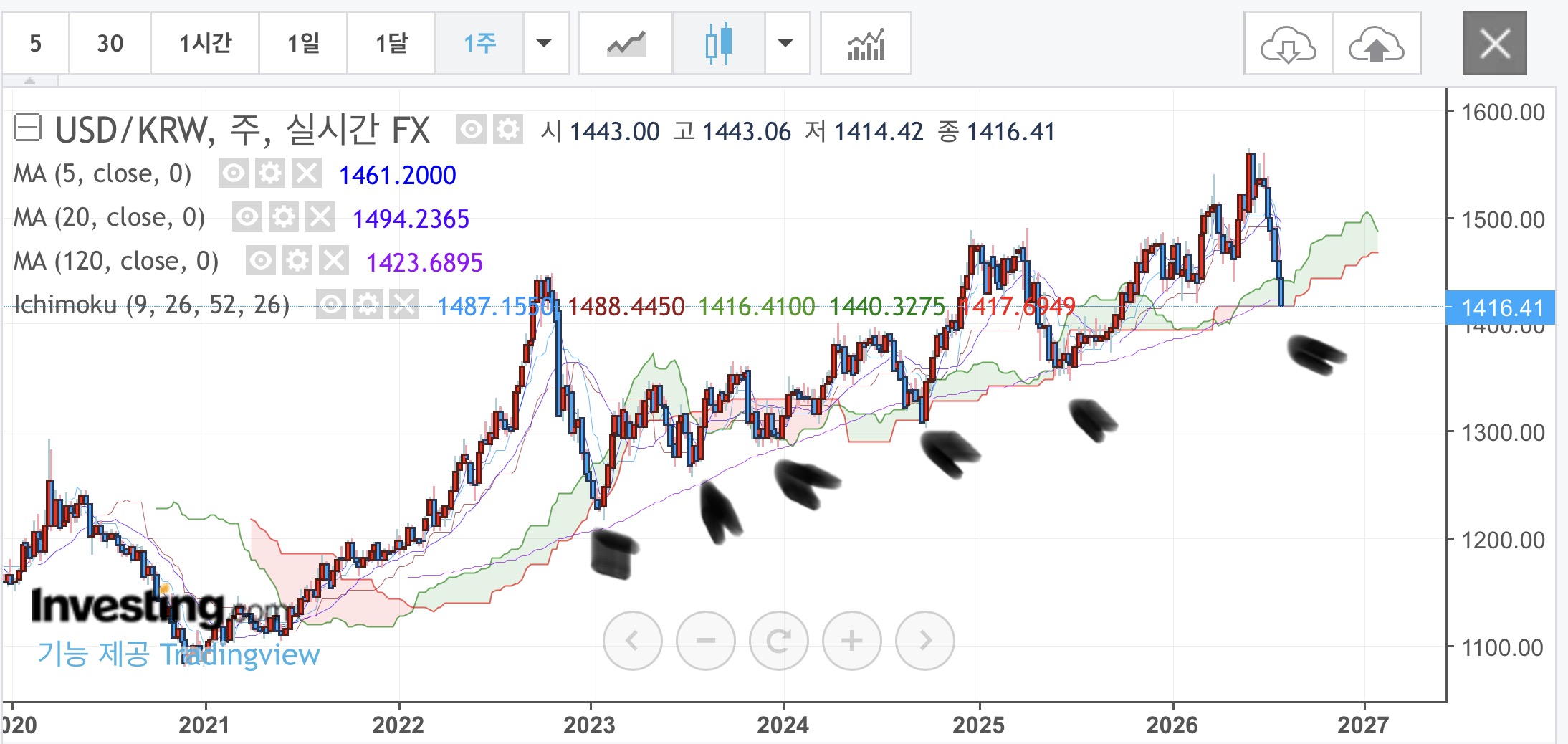
The current decline is approaching that same moving average, which some technical strategists read as a sign a reversal could be near. With the fundamentals-driven outlook (flows, policy) and the technical picture pointing in different directions, the exchange rate may spend the coming weeks caught between the two before a clearer trend emerges.

Newsroom
FX