The KOSPI closed lower after a fifth straight session of sharp swings, as foreign selling, profit-taking in large-cap semiconductor names, and renewed geopolitical risk in the Middle East combined to whipsaw the index intraday.
A More Than 250-Point Round Trip
The index opened at 6,365.07, up 68.69 points (1.09%) on bargain-hunting after the previous session’s steep pullback, and briefly reclaimed the 6,400 line, touching an intraday high of 6,415.60.
The mood reversed sharply by mid-morning. As foreign selling accelerated and risk appetite evaporated, the index fell as low as 6,158.73 intraday — a swing of more than 250 points from the open. Stocks pared some of the losses into the close, but the KOSPI still finished down 37.61 points (-0.60%) at 6,258.77. The KOSDAQ also turned lower for the first time in six sessions, closing at 798.81.
Two Forces Behind the Selloff — Hormuz Risk and a Jobs Report on Deck
The first driver was renewed Middle East risk. Overnight reports that Iran was weighing legislation to restrict passage through the Strait of Hormuz reignited geopolitical concern. Brent crude pushed back above $80 a barrel, weighing heavily on sentiment in a market with high dependence on imported oil.
The second was caution ahead of tonight’s U.S. jobs report, due out later in the Korea-time trading day. Investors leaned toward the sidelines, adding to the day’s volatility.
Winners and Losers
Bellwether Samsung Electronics held up with a modest 0.22% gain, but SK Hynix tumbled 4.88% on heavy profit-taking. Naver fell sharply too — down 7.08% — despite posting record quarterly revenue, as concerns over the cost of its AI infrastructure capex took center stage.
While large-cap semiconductor and tech names struggled, defense and battery stocks outperformed. Hanwha Aerospace rose 4.08%, Samsung SDI gained 7.49%, and LG Energy Solution added 4.35%, helping cushion the broader index.
Attention now turns to tonight’s U.S. employment report, which could determine which direction today’s volatility ultimately resolves.
Strategist View
Today’s swings are best understood as the latest chapter in a rollercoaster stretch for the KOSPI. The index hit an intraday all-time high of 9,385.59 on June 19, only to tumble as low as 5,262.77 by July 29 amid a slump in semiconductor stocks and deteriorating sentiment — a decline of roughly 4,123 points, or about 44%, from the peak.
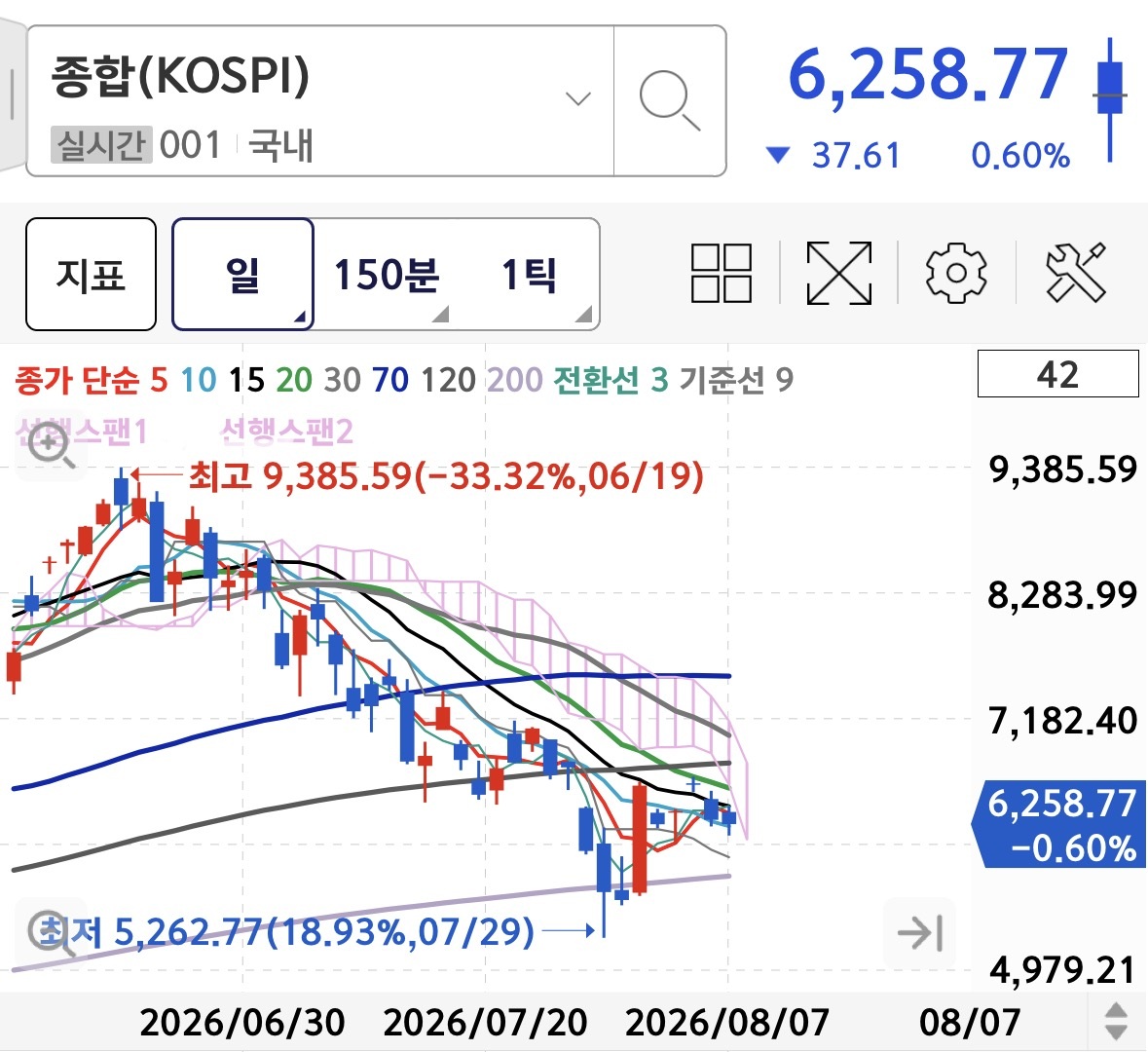
Since then, the index has found support near its 200-day moving average and has been working through a gradual recovery, according to technical analysts. Some point to the possibility of a golden cross forming soon near the 10- and 15-day moving averages, which are currently acting as resistance. Even so, the scale of today’s intraday volatility — driven by geopolitical risk and external events — is a reminder that any rebound remains fragile for now.

Newsroom
Domestic Equities