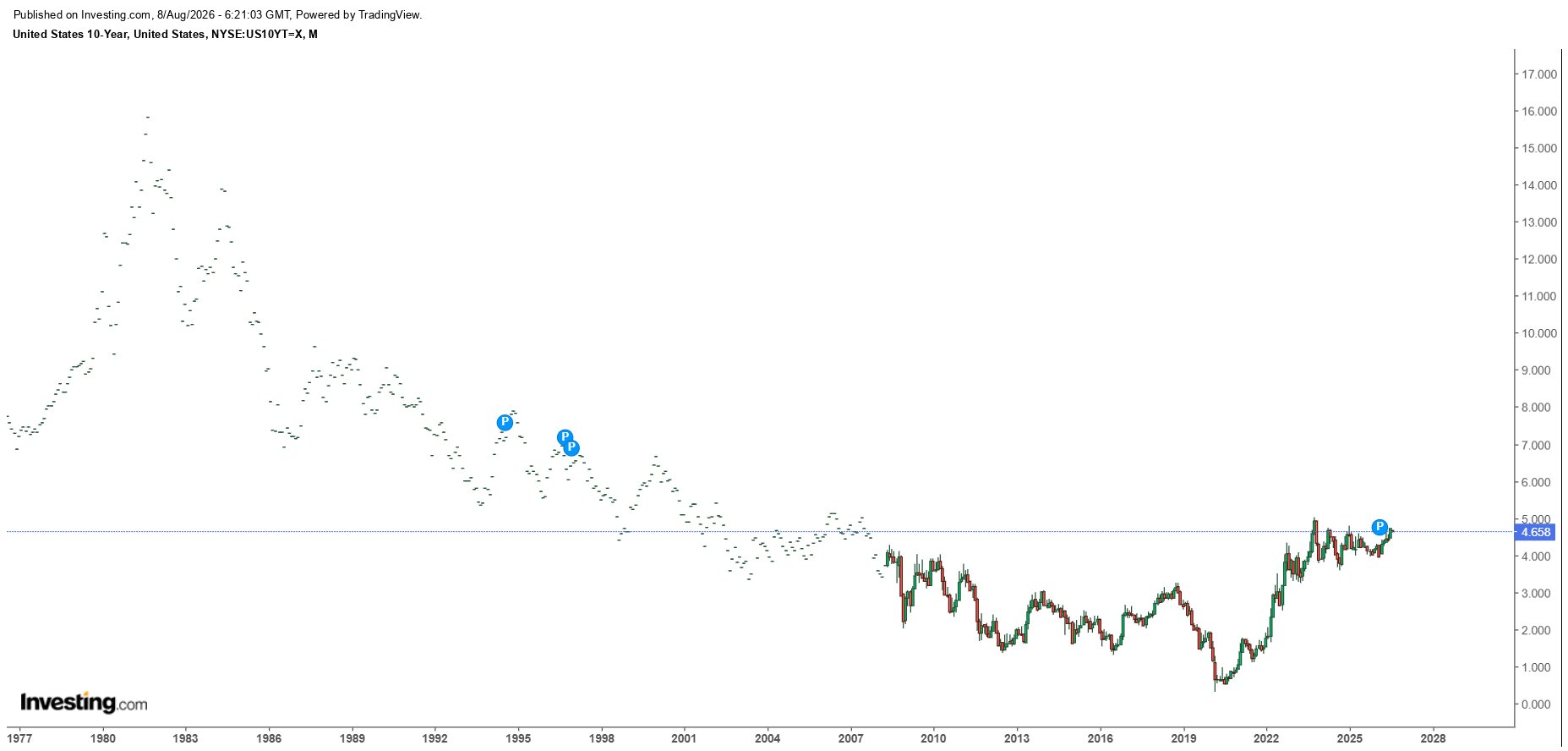
The 10-year U.S. Treasury yield has swung sharply over the past ten days. It rose after the Fed held rates steady on July 29 — of all things — then plunged to the 4.6% range within about a week and a half on the back of a jobs-report shock.
A Hold, Yet Yields Rose — Why?
On July 29, the Federal Reserve held its policy rate steady. The problem was the tone. Fed Chair Kevin Warsh emphasized that inflation was proving persistent, and three committee members reportedly favored a rate hike instead. Markets read this as a signal that policy wasn’t tight enough, and the result was an unusual pattern: Treasury yields and stocks fell together. Rising yields typically weigh on stocks on their own, but layered with this policy uncertainty, both bonds and equities came under pressure at once.
The Reversal — A Jobs Shock a Week Later
The mood flipped entirely with the U.S. July jobs report released on August 7. As we covered at the time, nonfarm payrolls fell by 23,000 — a genuine shock — and markets quickly priced back in a higher probability of Fed rate cuts. The 10-year yield plunged to 4.6% as a result.
The technical picture tells the same story. The 10-year yield peaked near 4.56–4.58% in early June, then traced a pattern of lower highs, repeatedly failing to clear resistance around 4.50% before sliding to roughly 4.39–4.40% more recently. Short-term structure looks tilted toward further weakness (lower yields), according to some analysts.
Why Long-Dated Yields Aren’t Falling as Fast — Fiscal Deficit Pressure
Not every maturity is moving the same way. According to the Korea Center for International Finance (KCIF), yields on Treasuries with five years or less to maturity have fallen sharply on rate-cut expectations, while 7-to-30-year yields have declined by much less. Analysts point to concern over the widening fiscal deficit and rising government debt, along with spillover from surging long-term yields in Japan and the U.K., as factors holding the long end up.
As a result, the spread between short- and long-dated yields has been widening. KCIF notes that this year, the 2-year yield has fallen 74 basis points and the 10-year 40 basis points — a divergence that’s steepening the curve.
What to Watch Next
Attention now turns to the Fed’s September meeting. A single jobs shock was enough to revive rate-cut expectations quickly, but the hawkish undercurrent at the Fed — strong enough that three committee members wanted a hike — hasn’t disappeared. Which way the next batch of data points could easily send yields swinging again.

newsroom
Bonds